
AS 2124 and AS 4000
A contractual and commercial analysis of delay notice obligations, time-bars, and the consequences of late notification on Australian infrastructure projects.
EXECUTIVE SUMMARY
Delay notification obligations under AS 2124 and AS 4000 are among the most litigated provisions in Australian construction contracts. Contractors who miss notice windows — even by days — frequently find their extension of time claims extinguished, their delay costs unrecoverable, and their programme rights forfeited.
This article examines the notice obligations under both standard forms, the legal and commercial consequences of late notification, and the practical steps contractors can take to protect entitlement from day one of any delay event.
Notice discipline is not a back-office administrative task. It is a front-line commercial right that must be exercised at the moment the delay event occurs — not when the scope is fully understood, not at the next commercial meeting, and not after the superintendent has already formed a view.
THE REGULATORY AND CONTRACTUAL FRAMEWORK
How AS 2124 and AS 4000 Govern Delay Notification
The two dominant standard form contracts used on Australian public and private infrastructure projects — AS 2124–1992 and AS 4000–1997 — both impose prescriptive notice obligations on contractors who experience delay events. The frameworks differ in their timelines and mechanisms, but both share a common feature: failure to comply with the notice regime can extinguish entitlement entirely, regardless of the merits of the underlying delay claim.
Under AS 4000, Clause 34.3 requires the contractor to give written notice to the superintendent within 14 days of the contractor becoming aware (or when it should reasonably have become aware) of a delay event. Under AS 2124, Clause 35.5 provides a longer window of 28 days from the occurrence of the delay. In both cases, the notice requirement is not merely procedural — it is a condition precedent to entitlement.
The Practical Difference Between 14 and 28 Days
In a complex construction environment, the difference between a 14-day and 28-day notice window is substantial. A site team managing programme pressure, subcontractor interfaces, and daily delivery challenges may not flag a delay event to the commercial team within two weeks. Under AS 4000, by the time the superintendent is formally notified in writing, the window has often already closed.
The 14-day period under AS 4000 begins to run not when the contractor actually becomes aware of the delay event, but when it ought reasonably to have become aware. This objective standard leaves limited room for contractors to argue they were unaware of an event that was plainly visible on site.
The 14-day notice window under AS 4000 begins to run when the contractor ought reasonably to have become aware of the delay event — not when it actually raised the issue internally.
CLAUSE COMPARISON
AS 2124 vs AS 4000 — Notice Obligations at a Glance
| OBLIGATION | AS 2124 – 1992 | AS 4000 – 1997 |
|---|---|---|
| Notice clause | Clause 35.5 | Clause 34.3 |
| Notice period | 28 days from delay event | 14 days from delay event |
| Form of notice | Written; to superintendent | Written; to superintendent |
| Particulars due | 28 days after notice (Cl. 35.6) | 14 days after notice (Cl. 34.4) |
| Time-bar | Entitlement lost if notice not given within 28 days | Entitlement lost if notice not given within 14 days |
| Compensation | Clause 36.2 — costs and time | Clause 34.7 — EOT and costs |
| Superintendent role | Must assess within reasonable time | Must assess within 28 days of particulars |
| Concurrent delay | Not expressly addressed; case law applies | Clause 34.5 addresses concurrent delay |
NOTICE WINDOW ANALYSIS
The Timeline From Delay Event to Entitlement Loss
The chart below maps the notice and particulars obligations under both standard forms across the 90-day period following a delay event. The shaded zones indicate where entitlement is most at risk. Under AS 4000, a contractor who fails to issue written notice by Day 14 may have no recoverable claim — even if delay costs run for months beyond that point.
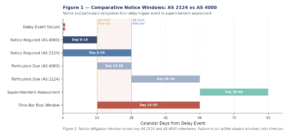
What the timeline illustrates is the asymmetry between the Principal’s position and the contractor’s. Once the time-bar operates, the Principal has no obligation to assess quantum, no obligation to consider the merits, and typically no commercial incentive to do so voluntarily. The contractor’s only remaining options are negotiation, dispute, or concession.
COMMERCIAL CONSEQUENCES
What Late Notice Actually Costs
The financial consequences of late delay notification tend to fall into three categories: direct entitlement loss, indirect programme damage, and downstream dispute exposure. Each compounds the other, and together they can convert a recoverable delay event into a structural project loss.
Direct Entitlement Loss
The most immediate consequence is the loss of the right to claim an extension of time and the associated delay costs. Under both AS 2124 and AS 4000, a contractor who does not give timely notice forfeits the extension of time claim — meaning liquidated damages continue to accrue against a programme that has been impacted by a delay the Principal caused or should share.
The cost impact is direct: delay costs that could have been recovered as additional preliminaries, plant costs, or prolongation are instead absorbed by the contractor. On a $50M project running at $150,000 per week in site overhead, a six-week delay event missed on notice can represent $900,000 in unrecoverable cost.
Liquidated Damages Exposure
Failing to claim an extension of time does not merely result in lost revenue — it leaves the contractor exposed to liquidated damages for a period that should have been excused. Where LDs are set at commercially significant rates (as is common on transport and infrastructure contracts), this exposure can exceed the value of the delay costs themselves.
This dynamic is particularly acute on AS 4000 projects where Clause 34.7 links EOT entitlement directly to cost recovery. A contractor who cannot establish an extension of time has, in most cases, also lost the right to claim associated compensation.
Superintendent Awareness Does Not Substitute for Written Notice
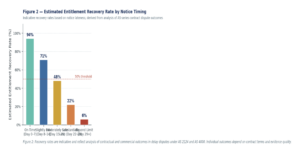
A common and costly misconception is that the superintendent’s actual knowledge of a delay event satisfies the notice obligation. It does not. Both AS 2124 and AS 4000 require written notice from the contractor. Verbal reports at site meetings, progress reports referencing delays, and RFI responses acknowledging programme impacts do not trigger the contractual notice mechanism and do not preserve entitlement.
Australian courts have consistently held that the contractual notice provisions are conditions precedent, not merely administrative requirements. A contractor who relies on the superintendent’s assumed awareness to avoid issuing formal written notice is, in most cases, taking an unacceptable commercial risk.
ROOT CAUSE ANALYSIS
Why Notice Obligations Are Missed
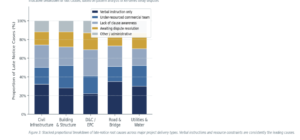
Late or missing delay notices are rarely the result of deliberate decisions. They tend to result from a combination of site culture, resource constraints, and a misunderstanding of the contractual mechanism. The chart below sets out the primary causes of notice failure across major project delivery types.
The Verbal Instruction Problem
The single most common failure point is the verbal direction: a superintendent or principal’s representative directs additional work, changes the sequence, or restricts access — verbally, at a site meeting or on the ground. The site team responds and delivers. The commercial team is notified later — or not at all.
By the time the delay claim is prepared, the 14-day or 28-day window has passed. The claim is rejected on notice grounds, despite the fact that the superintendent was present when the direction was given and the additional work is clearly visible in site records.
The Resource Gap
Commercial teams on major infrastructure projects are frequently under-resourced relative to the volume of contract administration work the project generates. Notice obligations compete with variation registers, payment claims, RFI registers, and programme updates. Where there is no dedicated delay notice protocol, notice obligations fall through the gaps.
This is a structural problem: it is not solved by reminding staff of their obligations. It is solved by building a notice workflow that operates independently of the commercial team’s day-to-day workload, with clear ownership, templated notices, and escalation triggers.
Notice obligations are not solved by reminding staff. They are solved by building a workflow that operates automatically from the moment a potential delay event is identified on site.
COST EXPOSURE MODELLING
How Delay in Noticing Compounds Cost Exposure
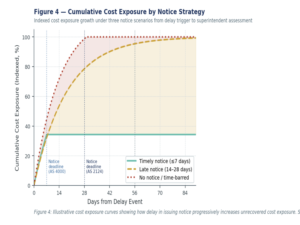
The chart below models cumulative cost exposure under three notice scenarios: timely notice within 7 days, late notice between 14 and 28 days, and no notice at all. The shaded bands between curves represent the incremental cost that becomes unrecoverable as notice is delayed.
The key insight is not merely that late notice causes loss — it is that the loss is front-loaded. The majority of unrecoverable cost exposure is incurred in the first 30 days after the delay event, before most commercial teams have even begun preparing a claim.
THREE COMMON MISCONCEPTIONS THAT COST CONTRACTORS ENTITLEMENT
“The superintendent knows about the delay.” Superintendent awareness does not substitute for written notice. The contractual obligation is procedural and sits with the contractor. Actual knowledge by the Principal’s representative does not trigger or extend the notice window.
“We’ll include it in the next progress report.” Progress reports referencing delays do not constitute valid notice under AS 2124 or AS 4000 unless they explicitly state an intention to claim and are addressed to the superintendent in the form required by the contract.
“We’ll sort it out at the end of the project.” Close-out negotiations do not restore time-barred entitlements. A claim that is contractually extinguished at Day 15 is still extinguished at project close-out. Principal goodwill is not a substitute for contractual compliance.
CLAUSE RISK ANALYSIS
Notice Clauses That Generate the Most Disputes
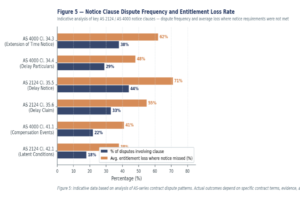
Not all notice clauses carry equal risk. The chart below maps the frequency with which specific clauses feature in delay disputes, alongside the average entitlement loss where the notice requirement was not met. Clause 35.5 of AS 2124 and Clause 34.3 of AS 4000 consistently generate the highest volume of disputes and the greatest financial exposure.
PRACTICAL GUIDANCE
What Contractors Should Do — and When
The following steps reflect what a well-run commercial function does in practice to manage delay notice obligations under AS 2124 and AS 4000. They are structured around the same three phases used in PCAG’s standard commercial risk review: before contract execution, during delivery, and at close-out.
Before Works Commence
- Map every notice clause. At contract award, produce a clause matrix that identifies every notice obligation in the contract, the trigger event, the required form, the time limit, and the responsible person. Under AS 4000, this should capture Clauses 34.3, 34.4, 34.7, 41.1, and 12 as a minimum.
- Establish a delay notice register from day one. The register should be maintained alongside the variation and EOT registers, with a separate column for notice status and days remaining. It should be reviewed at every weekly commercial meeting.
- Brief site leadership on the trigger events. Forepersons, site managers, and project engineers should understand what constitutes a delay trigger and how to escalate it. A single-page field guide works better than a contract clause reference.
- Agree a notice template with the superintendent. A pre-agreed format for delay notices reduces turnaround time and avoids disputes about form. It also signals commercial competence to the Principal from the outset.
During Construction
- Issue notice immediately on identification of a potential delay event. Do not wait to quantify the impact. The obligation under AS 4000 runs from when the delay event is identified, not when its full scope is understood. Issue notice first. Quantify later.
- Follow written direction with written notice — every time. If the superintendent gives a verbal direction that has programme implications, issue a written notice within 24 hours. Do not rely on meeting minutes, emails acknowledging the direction, or the superintendent’s awareness.
- Track the 14-day window on the register daily. In the two weeks following a delay event, the notice register should be reviewed daily by the commercial manager. At Day 10, if no notice has been issued, escalate immediately.
- Substantiate with contemporaneous records. Site diaries, daily allocation records, photographs, resource schedules, and RFIs should be captured in real time and linked to the relevant delay event on the register. Particulars submitted without contemporaneous records are routinely challenged on quantum grounds.
- Keep delay and variation registers linked. Most delay events generate both a variation claim and an EOT claim. The notice obligations for each may be different. Manage them in the same document to avoid treating them as separate commercial tracks.
At Close-Out
- Audit the notice register before submitting the final account. Identify any delay events where notice may have been late, incomplete, or given in the wrong form. Assess whether alternative grounds of entitlement — such as Clause 12 latent conditions, contract ambiguity, or superintendent breach — can be argued to circumvent the time-bar.
- Prepare a structured EOT schedule cross-referenced to notices. The final account EOT schedule should map each delay event to the relevant notice, the particulars submission, the superintendent’s assessment, and the outstanding claim. A well-structured schedule is materially more persuasive than a narrative claim.
- Engage specialist advisors before any formal dispute is commenced. Where a time-barred claim is material, specialist advice on the legal basis for avoiding the time-bar should be sought before correspondence with the Principal escalates. Courts and arbitral tribunals have, in limited circumstances, declined to apply time-bars where the result would be unconscionable — but this is not a reliable fallback.
CASE EXAMPLE
Light Rail Stage 3 Extension — Civil Interface Package (AS 4000)
THE SITUATION
A civil subcontractor working on a major light rail extension encountered a series of delay events over a six-week window: late design issue from the principal, a sovereign authority interface conflict, and an unplanned utility strike. Each event independently triggered Clause 34.3 notice obligations under AS 4000 — requiring written notice to the superintendent within 14 days of each trigger.
WHAT HAPPENED
The site team verbally reported each event at weekly progress meetings and understood the superintendent was aware. Formal written notices were not issued. By the time the commercial team prepared delay claims — approximately 45 days after the last delay event — all three notice windows had closed. The superintendent rejected each claim on notice grounds alone, without assessing quantum or entitlement.
THE FINANCIAL CONSEQUENCE
The contractor had incurred approximately $2.1M in identifiable delay costs across the three events. Following the notice rejections, $1.7M remained unrecoverable through contractual mechanisms. The remaining $400K was partially recovered by framing one event as a latent condition under Clause 12 — which carried a separate, longer notice period.
THE LESSON
Superintendent awareness of a delay event does not substitute for written notice under AS 4000. The obligation is procedural and time-bound. Once the 14-day window closes, entitlement is generally extinguished regardless of the merits of the underlying claim.
KEY TAKEAWAYS
What to Take Back to Site
01 The 14-day window is not a guideline.
Under AS 4000, the notice period is a condition precedent. Once it closes, entitlement is generally gone — regardless of how legitimate the underlying delay claim is. Act at the moment of trigger, not at the next meeting.
02 Superintendent awareness is not written notice.
The contractual obligation sits with the contractor. A superintendent who knows about the delay and does nothing has not excused the contractor from its notice obligation. Issue notice in writing, addressed to the superintendent, in the form the contract requires.
03 The longer window under AS 2124 creates a false sense of security.
Twenty-eight days sounds manageable. In practice, it passes quickly on a busy site. Build the notice obligation into the weekly commercial rhythm from day one, not from the day you realise the window is closing.
04 Progress reports do not substitute for formal notice.
References to delays in weekly progress reports, meeting minutes, or RFI responses do not trigger the contractual notice mechanism. Only a document that explicitly gives notice of a delay event — addressed to the superintendent — satisfies the obligation.
05 Early advisory support prevents the loss, not just recovers it.
PCAG’s most effective engagements are at contract award, not at dispute. A notice workflow built into delivery costs a fraction of the claims that walk out the door through missed notices.
Is your project managing delay notices effectively?
PCAG reviews delay notice registers, EOT submissions, and superintendent correspondence to identify at-risk entitlements — and structure a recovery pathway before the window closes.
Contact PCAG Today · pcag.com.au · Analysis · Solutions · Results
This article is prepared for general informational purposes and does not constitute legal, contractual, or financial advice. All data and figures presented in charts are indicative, based on analysis of AS-series delay dispute patterns, and are intended for illustrative purposes only. Contractors should seek specialist commercial and legal advice in relation to their specific contractual circumstances.